Whether and how immigration affects labor markets is a widely-studied topic. By contrast, the converse question of how emigration impacts labor markets in the source economy has remained largely understudied. Only a handful of studies have examined whether outflows of laborer’s lead to higher wages in their home countries. New research by Mateusz Filipski, Hak Lim Lee, Aung Hein and Ulrike Nischan contributes to filling this knowledge gap. It draws from survey data of 1680 households undertaken in rural Mon State, a southern state neighboring Thailand undertaken by the joint Michigan State University and IFPRI Food Security Program in 2105.
The wage differential between Myanmar and Thailand prompts many workers to seek jobs across the border. Nowhere is this phenomenon more pronounced than in Mon State, where the survey data shows that over a quarter of the rural labor force is working abroad. Our analysis reveals that the variation in wage levels across rural Mon State is intimately related to migration strongly suggesting that emigration is causing a significant upward effect on wages for unskilled agricultural workers (Figure 1).
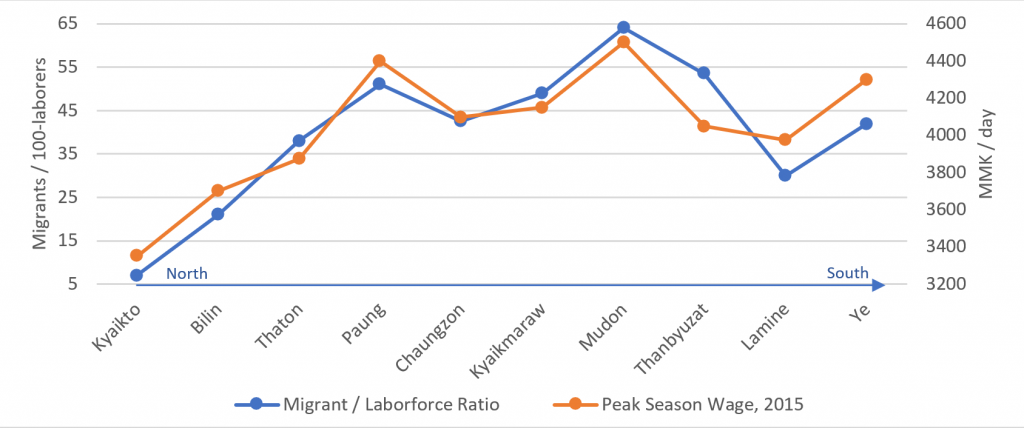
Areas with a surplus of cheap labor can send large portions of their workforce away without experiencing any labor shortage or wage impact. However, Mon State is neither very large nor very remote, yet there is enough wage variation to reveal strong effects, suggesting that there is not a large labor surplus in Mon State and the labor supply is very elastic. Rural areas of Mon State still demand labor, and struggle to satisfy that demand.
Economic theory would suggest that as migrants move from low-wage to high-wage areas, wages should equalize over time. Indeed, just as Mon State residents are moving to Thailand, there exist flows of temporary migrant workers coming from more northern regions of Myanmar to fill some of the void left by Mon workers. However, these movements are primarily seasonal (harvest time) and have not led to a geographic equalization of wages. Frictions in the labor markets and transportation costs may ensure that the current wage gradient between central Myanmar, Mon State, and Thailand, is maintained in the short-to-medium run. As long as that is the case, we are likely to see continued migration flows.
 Higher wages have deep consequences for farmers, who often operate at very low margins and may not be able to cope with rising labor costs. Typically, farmers will alter their agricultural practices as they face rising wages to reduce labor use. However, there is limited evidence that these mechanisms are taking place. The paper suggests that farm households with migrants were less likely to hire workers or use animal drought power. They were however more likely to own rubber trees and motor vehicles (suggesting investment) but less likely to hire workers to tap those trees (suggesting prohibitive wages).
While the research results are only applicable to Mon State, the implications are relevant for all of Myanmar. Rising rural wages may create excessive strain on agricultural profits, and mechanization may not be enough to ensure farm profitability and long-term viability. Economists have speculated that Myanmar might follow an agriculture-led growth path, but the lack of abundant and affordable labor may jeopardize this prospect. Beyond farming, a rapid rise in wages may prevent small-scale industry development and thwart the hopes for economic transition. Additional work of the newly launched Feed the Future Myanmar Agriculture Strategy Support Program will examine how wages may impact development paths in Myanmar.
You can read the full paper here.